
Advisory, September 2026
How property actually compounds
NCR property beat Indian equities over the last seven years. That is a specific market, specific window result, and the fees and taxes are where returns are actually decided.
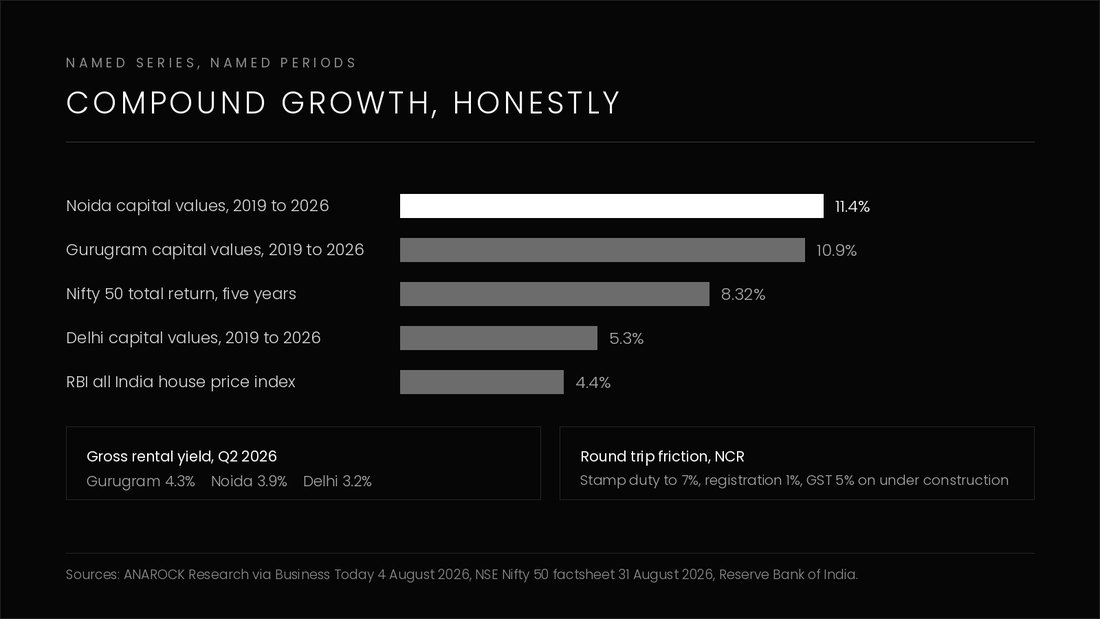
The claim that Indian real estate beats everything else is usually made with no series attached. So here are the series, named, dated, and with the awkward numbers left in.
The all India picture is modest. The Reserve Bank's House Price Index, built from transaction level data supplied by property registration authorities across eighteen cities, stood at 117.5 in the quarter to June 2026 on a 2022-23 base of 100, up 3.6 per cent year on year. That is roughly 4.4 per cent compound since the base year. The National Housing Bank's RESIDEX fifty city composite rose 4.5 per cent year on year in the quarter to March 2026.
Inside that average, dispersion is enormous. In NHB's assessment price series for the quarter to March 2026, Delhi fell 4.3 per cent year on year, the largest decline of all fifty cities. In the preceding quarter Gurugram rose 22.8 per cent, the largest rise of all fifty. Both are the same index in the same year. Anyone quoting a national number to you about a Gurugram purchase is not telling you anything useful.
ANAROCK's capital values series, which measures primary market prices in selected micro markets rather than registrations, runs from 2019 to the June 2026 quarter: Noida from Rs 4,795 to Rs 10,780 per sq ft, a 125 per cent rise, roughly 11.4 per cent compound. Gurugram from Rs 6,150 to Rs 13,350, 117 per cent, roughly 10.9 per cent compound. Delhi from Rs 18,200 to Rs 26,700, 47 per cent, roughly 5.3 per cent compound. Gross rental yields over the same period rose from 3.5 to 4.3 per cent in Gurugram, 3.2 to 3.9 in Noida, and 2.2 to 3.2 in Delhi.
Against that, the Nifty 50 total return index, on NSE's own factsheet at 31 August 2026, compounded at 8.32 per cent over five years and 12.38 per cent since inception in 1996. Over the last twelve months it was down 0.35 per cent, and down 7.00 per cent for the calendar year to date.
So the honest statement is this. Gurugram and Noida property, in the primary market, compounded at around 11 per cent over 2019 to 2026 and paid a 4 per cent gross yield on top, and beat Indian equities over that window. Over the longer run the Nifty total return index has compounded at 12.38 per cent while the national house price index has compounded at about 4.4 per cent. NCR outperformance is a specific market over a specific window, not a law of nature. Note too that average unit size in NCR rose from 1,375 to 2,466 sq ft between 2022 and 2025, so a good part of what looks like price growth is a larger flat rather than the same flat costing more.
Now the part that decides your actual return. Long term capital gains on land or building are taxed at 12.5 per cent without indexation for transfers on or after 23 July 2024, with a twenty four month holding period. Section 197 of the Income-tax Act 2025 preserves the grandfathering: a resident individual or HUF selling land or building acquired before 23 July 2024 effectively pays the lower of 12.5 per cent without indexation and 20 per cent with it. Non residents get no such option, which matters a great deal in this market.
The rollovers, in the numbering of the new Act. Section 82, formerly 54, on a residential house: purchase within one year before or two years after, or construct within three, with the cost of the new asset capped at Rs 10 crore. Section 86, formerly 54F, applies the Rs 10 crore cap twice over, once to the cost of the new asset and separately to the net consideration on the original. Section 85, formerly 54EC: land or building only, invested within six months, ceiling Rs 50 lakh across the year of transfer and the next taken together, in bonds redeemable after five years.
Then friction. Stamp duty in Delhi is 6 per cent for men, 4 for women, 5 for joint holders, plus 1 per cent registration. Urban Haryana is 7, 5 and 6 per cent, with the registration fee capped at Rs 50,000 above Rs 90 lakh. Uttar Pradesh is 7 per cent for men and 6 for sole women, with a 1 per cent concession for women on properties up to Rs 1 crore, plus 1 per cent registration with no general cap. GST is 5 per cent without input credit on under construction non affordable housing and nil on completed property with an occupancy certificate. Add brokerage on both sides and a round trip in NCR costs high single digits to low double digits of the price before you have made anything.
And litigation, which people underweight. Damle and Gulati at NIPFP analysed 90,142 Delhi High Court judgments from 2007 to 2019 and found land and property disputes made up 17 per cent of all litigation before that court. Of the sampled property cases, 34.3 per cent were eviction, 24.3 per cent challenges to land acquisition and 17.6 per cent contractual. Only 13.6 per cent arose from property record problems, which is the opposite of the received wisdom.
If you want property exposure without the friction, six REITs are listed in India, distributing Rs 3,136 crore in the June 2026 quarter across a combined gross asset value above Rs 3.17 trillion. SEBI's small and medium REIT framework, issued in June 2024, allows schemes of Rs 50 crore to under Rs 500 crore with a minimum unit price of Rs 10 lakh and at least 95 per cent of assets in completed revenue generating property. Only one operator has actually listed schemes under it, with three as at May 2026, at pre tax distribution yields of roughly 8.4 to 9 per cent.
Our summary, and it is deliberately unexciting. Property compounds through a handful of correct decisions about location and timing, then hands most of the gain back through stamp duty, brokerage, tax and the years a bad title takes to resolve. Nobody can currently quote you a clean twenty year Indian house price compound rate, because both official indices were rebased in March 2026 and long run comparability is broken. Be suspicious of anyone who offers you one.
Sources
- Reserve Bank of India House Price Index for Q1 2026-27, as reported 24 August 2026
- NHB RESIDEX press release, January to March 2026
- Business Today, 4 August 2026, reporting ANAROCK price and yield series
- NSE Nifty 50 factsheet, 31 August 2026
- Income Tax Department, tax on long term capital gains
- Damle and Gulati, NIPFP Working Paper 349, August 2021
- SEBI frequently asked questions on small and medium REITs
Checked at the date on this entry. Figures move, and reporting is sometimes corrected after publication. Ask us for the current position before you act on any of it.