
Advisory, September 2026
When agricultural land stops being agricultural
Rural agricultural land is not a capital asset, so selling it produces no capital gain. The test that decides which side of the line you are on is arithmetic, not opinion.
Start with the change that most published material has not caught up with. The Income-tax Act 1961 was repealed on 1 April 2026. The Income-tax Act 2025, which received assent on 21 August 2025, is the law now. The substance of the agricultural land rules is carried across almost unchanged, but every section number has moved. Anything you read that cites section 2(1A) or section 54B as current law was written for a statute that no longer exists.
Agricultural income is now defined in section 2(5). The exemption runs through section 11(1) and Schedule II. The definition has the same three limbs: rent or revenue from land in India used for agricultural purposes, income from agriculture and from the market preparation processes a cultivator ordinarily employs, and income from a farm building. It expressly excludes income from a building or land used for non agricultural purposes.
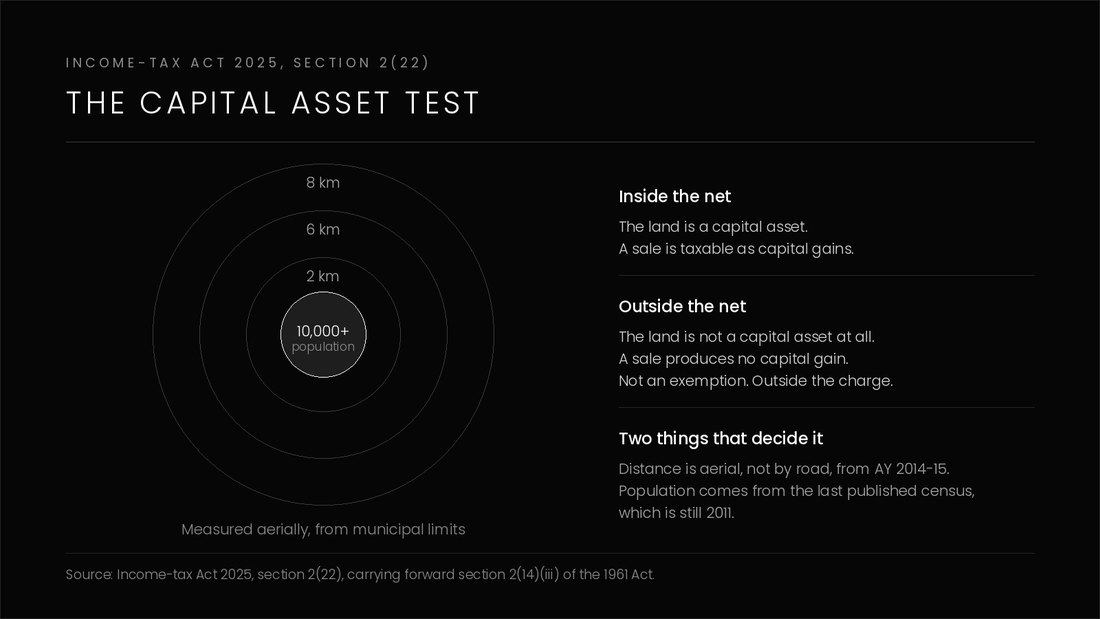
The test that decides whether a sale is taxable at all is in section 2(22), which defines a capital asset. Agricultural land is not a capital asset unless it sits within a municipality or cantonment board with a population of 10,000 or more, or within a set aerial distance of one: 2 km where the population is between 10,001 and 1,00,000, 6 km where it is between 1,00,001 and 10,00,000, and 8 km where it is above 10,00,000. If your land falls outside that net it is not a capital asset, and a sale generates no capital gain. Not an exemption. Outside the charge altogether.
Two details in that test do a great deal of work. First, distance is measured aerially. That was introduced by the Finance Act 2013 with effect from assessment year 2014-15; before that the courts required the shortest road distance. The Bombay High Court held the amendment prospective in Maltibai R. Kadu in March 2015, and the CBDT accepted that position. Second, population is taken from the last preceding census whose figures were published before the start of the tax year. No later census figures have been published, so the 2011 Census still governs. A village on the edge of Gurugram that has quadrupled since 2011 is still assessed on its 2011 number. That is a trap in both directions.
Whether land is agricultural at all is a question of fact, not of what the revenue record says. The Supreme Court in Sarifabibi Mohmed Ibrahim, decided in September 1993, approved a thirteen factor enquiry: how the land is classified in revenue records, whether it is actually being cultivated and how permanently, whether it has been plotted and roaded, whether it was sold by the yard or by the acre, and whether an agriculturist would pay that price to farm it. Not every factor need be present. And the meaning of agriculture itself comes from Raja Benoy Kumar Sahas Roy in 1957: basic operations on the land, tilling, sowing, planting, must precede the subsequent operations, or the subsequent operations do not qualify.
The farmhouse point, since this is Delhi. Income from a building counts as agricultural income only where the building is occupied by the cultivator or the receiver of rent, sits on or near the land, is required as a dwelling, store house or out building by reason of the connection with the land, and the land is either assessed to land revenue or falls outside the urban limits above. A Chattarpur or Sohna weekend house let for events, shoots or residence does not meet that. It produces ordinary taxable income. Land let for a non agricultural use fails the first limb for the same reason.
Rollover relief is now section 83, formerly section 54B. It is available only to an individual or HUF. The land must have been used for agricultural purposes by you, your parent, or the HUF for the two years immediately before the transfer. New agricultural land must be bought within two years after. Anything unutilised goes into the Capital Gains Account Scheme before the return filing due date. And if the new land is sold within three years, its cost is reduced by the exempted gain, which claws the relief back.
Even where the land itself is outside the charge, agricultural income above Rs 5,000 is aggregated with your other income for rate purposes under the annual Finance Act. It does not become taxable. It pushes the rest of your income up the slab. The Finance Act 2026 retains that rule, and this year it carries two rate schedules because both statutes are live across the transition.
On change of land use, the practical position. In Haryana, section 7 of the Punjab Scheduled Roads and Controlled Areas Act 1963 requires the permission of the Director, Town and Country Planning, plus conversion charges, before land in a controlled area is used for anything other than its use at the date of notification. Application is on Form CLU-I to the District Town Planner with a scrutiny fee of Rs 10 per sq m, and a decision is to be conveyed within ninety days. Penalties under section 12 run to three years imprisonment and demolition recoverable as arrears of land revenue. We are not printing a conversion charge figure, because the official schedule varies by potential zone and use and the per acre numbers on broker sites are self described as illustrative.
In Uttar Pradesh the route is section 80 of the UP Revenue Code 2006, applied to the Sub Divisional Officer by a bhumidhar with transferable rights. Note the trap in section 80(2): a declaration for intended future use requires a boundary wall, lapses if activity does not start within five years, and the section says in terms that such a declaration does not amount to change of land use. The land stays agricultural on the record. An ordinance promulgated on 8 April 2026 now deems a building or development permission granted by a Development Authority to constitute the section 80 declaration, with revenue records to be corrected within fifteen days and no fee charged.
One thing to be clear about, because it is widely misstated. Change of land use does not itself change the income tax character of your land. The tax test is section 2(22) and the Sarifabibi enquiry. But a CLU is powerful evidence in that enquiry, and the Revenue uses it that way. That is analysis, not a rule, and it is the point at which you should be talking to a tax adviser rather than reading an article.
Sources
- Income Tax Department, on the repeal of the 1961 Act and scope of the 2025 Act
- Income Tax Department, agricultural income
- Income Tax Department, exemption on transfer of agricultural land
- Punjab Scheduled Roads and Controlled Areas Act 1963, sections 6, 7 and 12
- Uttar Pradesh Revenue Code 2006, section 80
- Finance Bill 2026, clause 2, on aggregation of agricultural income
Checked at the date on this entry. Figures move, and reporting is sometimes corrected after publication. Ask us for the current position before you act on any of it.