
Advisory, September 2026
Selling quietly, and why it produces a better number
A home on eleven portals for nine months negotiates from weakness. A home shown to eight qualified buyers does not.
There is no mystery to why discretion produces a better price, and it has nothing to do with exclusivity as a feeling. It is about information. Every week a property sits publicly listed, the market learns something: that it has not sold, that the seller is still there, and eventually that the price was wrong. None of that information helps you. All of it helps the buyer.
A public listing also destroys your best negotiating asset, which is the buyer's uncertainty about how many other people are interested. Once a listing has been up for six months on multiple portals with the price visibly reduced twice, every buyer knows the answer to that question. They will open below your last reduction, and they will be right to.
What we do instead is unglamorous. We build a written file first: title chain, encumbrance, approvals, society or maintenance dues, tax position, and the registered comparables from the same tower or the same street rather than the asking prices from a portal. Then we value it from those registered transactions and tell you the number, including when the number is lower than you were hoping. Then the property goes to a named list, usually somewhere between six and fifteen buyers and family offices who we know are looking for exactly that thing, with the file attached.
The effect is that the first conversation is with someone who already has the answers to the questions that usually cause a deal to stall three weeks in. It is also that nobody is bidding against a public price. They are bidding against the possibility of another private buyer, which is a much better position for you to be in.
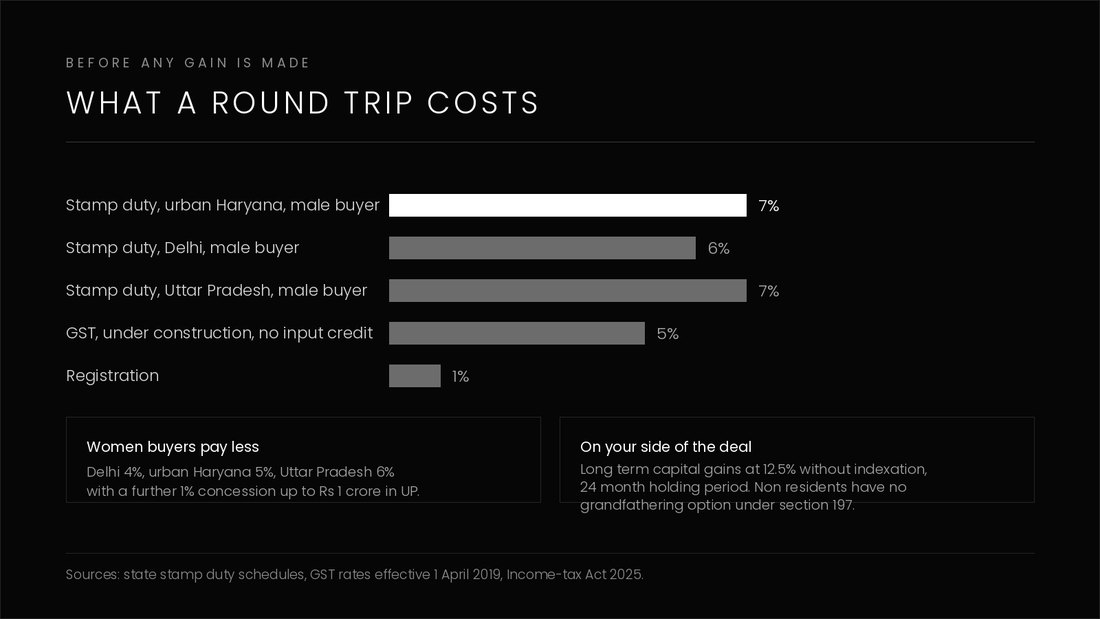
The arithmetic on the other side is worth knowing before you set a reserve. Stamp duty in urban Haryana is 7 per cent for a male buyer, 5 for a female and 6 for joint holders, with the registration fee capped at Rs 50,000 above Rs 90 lakh. Delhi is 6, 4 and 5 per cent plus 1 per cent registration. Uttar Pradesh is 7 per cent, or 6 for a sole female buyer, with a 1 per cent concession for women up to Rs 1 crore, plus 1 per cent registration with no cap. GST is 5 per cent without input credit on under construction non affordable stock and nil once an occupancy certificate is issued. Your buyer is paying all of that on top of your price, and it is part of what they can afford.
On your own side, long term capital gains on land or building run at 12.5 per cent without indexation for transfers on or after 23 July 2024, with a twenty four month holding period. If you acquired before that date and you are a resident individual or HUF, section 197 of the Income-tax Act 2025 lets you effectively pay the lower of that and 20 per cent with indexation. If you are non resident, you do not have that option, and it is often the single largest number in the transaction. Work it out before you agree a price, not after.
The last piece is timing, and it is the one sellers most often get wrong. A property that is being sold because of a deadline gets a deadline price. If you have a reason to sell by a particular date, tell us at the start so we can build the process backwards from it. If you do not, do not create one, and do not tell anyone you have one.
Sources
- ClearTax, stamp duty and registration charges in Haryana
- ClearTax, stamp duty and registration charges in Delhi
- Income Tax Department, tax on long term capital gains
Checked at the date on this entry. Figures move, and reporting is sometimes corrected after publication. Ask us for the current position before you act on any of it.